A Love Supreme returns
Published on 14.09.2026, 17:23
On 16, 17 and 18 September, Anne Teresa De Keersmaeker and Salva Sanchis' A Love Supreme returns to the stage at Ancienne Belgique in Brussels, presented as part of (John) Coltrane 100 — a citywide tribute marking the 100th birthday of jazz icon John Coltrane, co-presented by Ancienne Belgique, Bozar and Kaaitheater.
A Love Supreme is a dance quartet set to John Coltrane's eponymous 1965 album, recorded in a single session with his Classic Quartet — Coltrane himself, pianist McCoy Tyner, bassist Jimmy Garrison and drummer Elvin Jones. The album, which Coltrane described as a humble offering of gratitude to God, became a cornerstone of jazz because of the carefully balanced interplay between improvisation and structure, the combination of meticulous form and raw energy, and the powerful blend of the styles expressed by the four soloists.
De Keersmaeker and Sanchis first translated this interplay into dance in 2005, welcoming the challenge of interweaving improvisation and composition, allowing them to merge into a seamless whole.
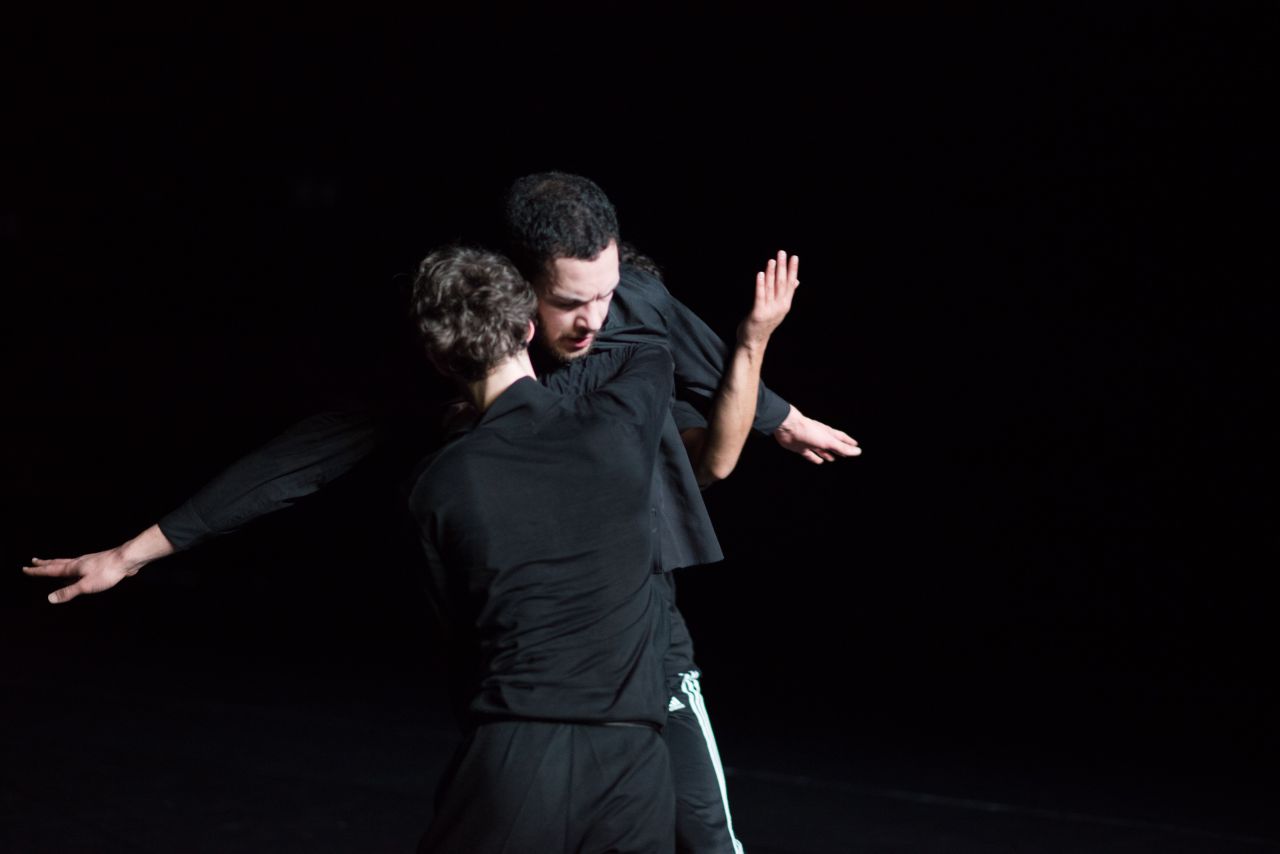
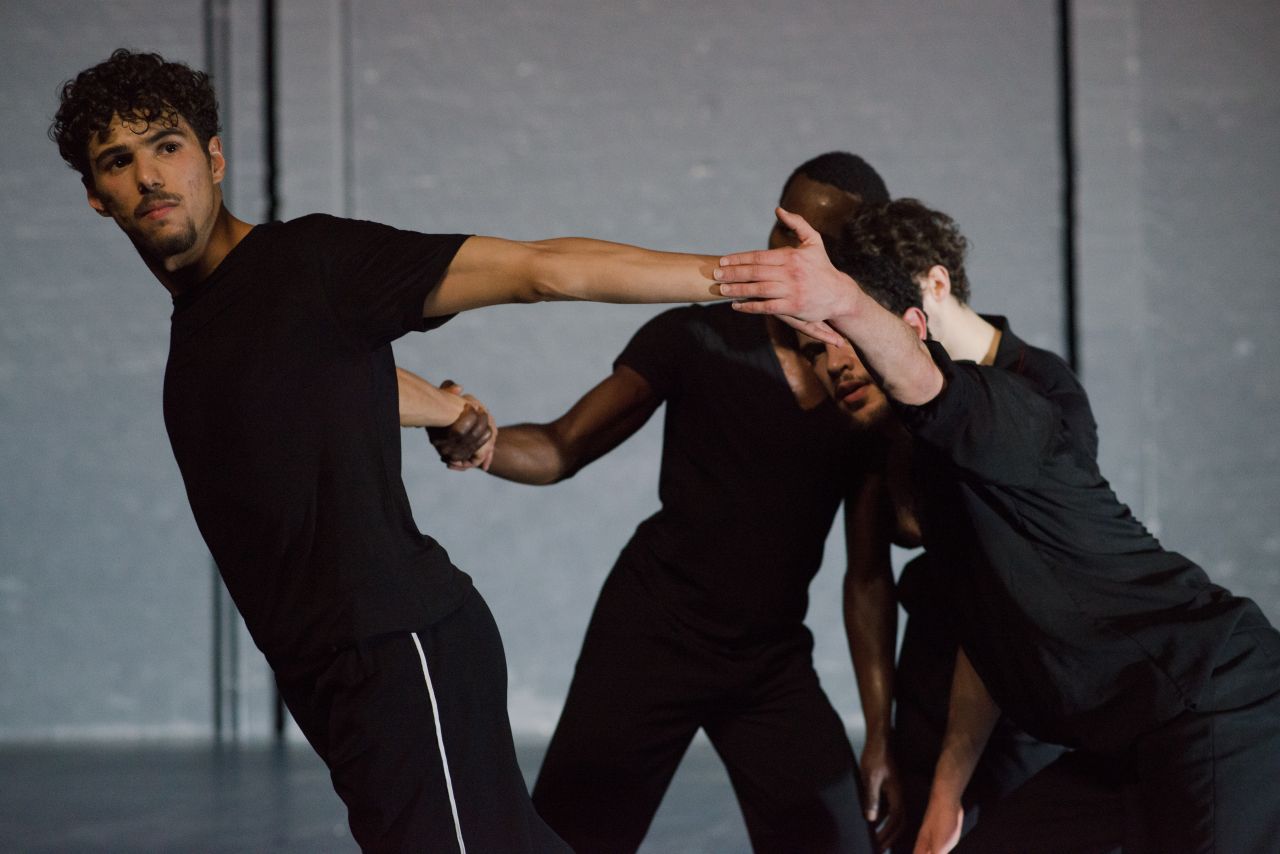
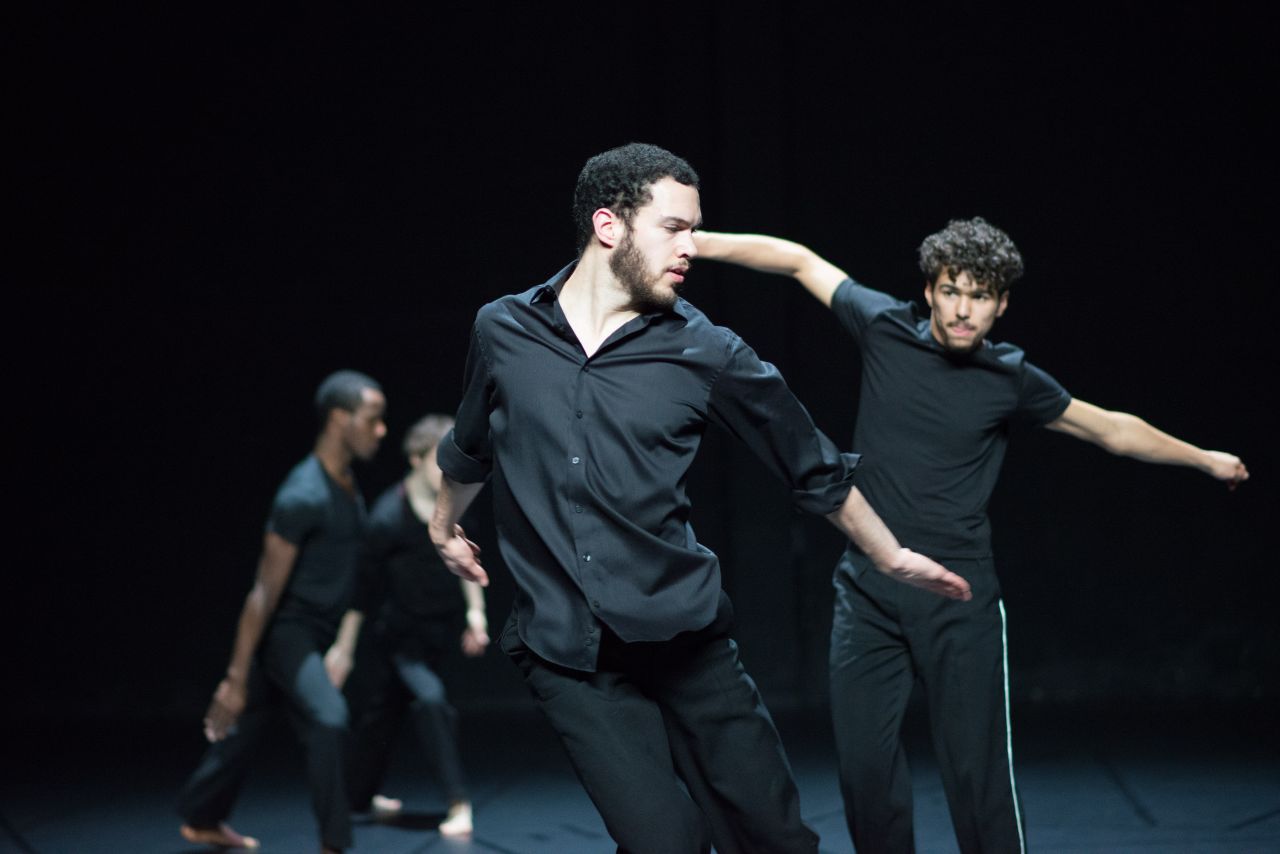
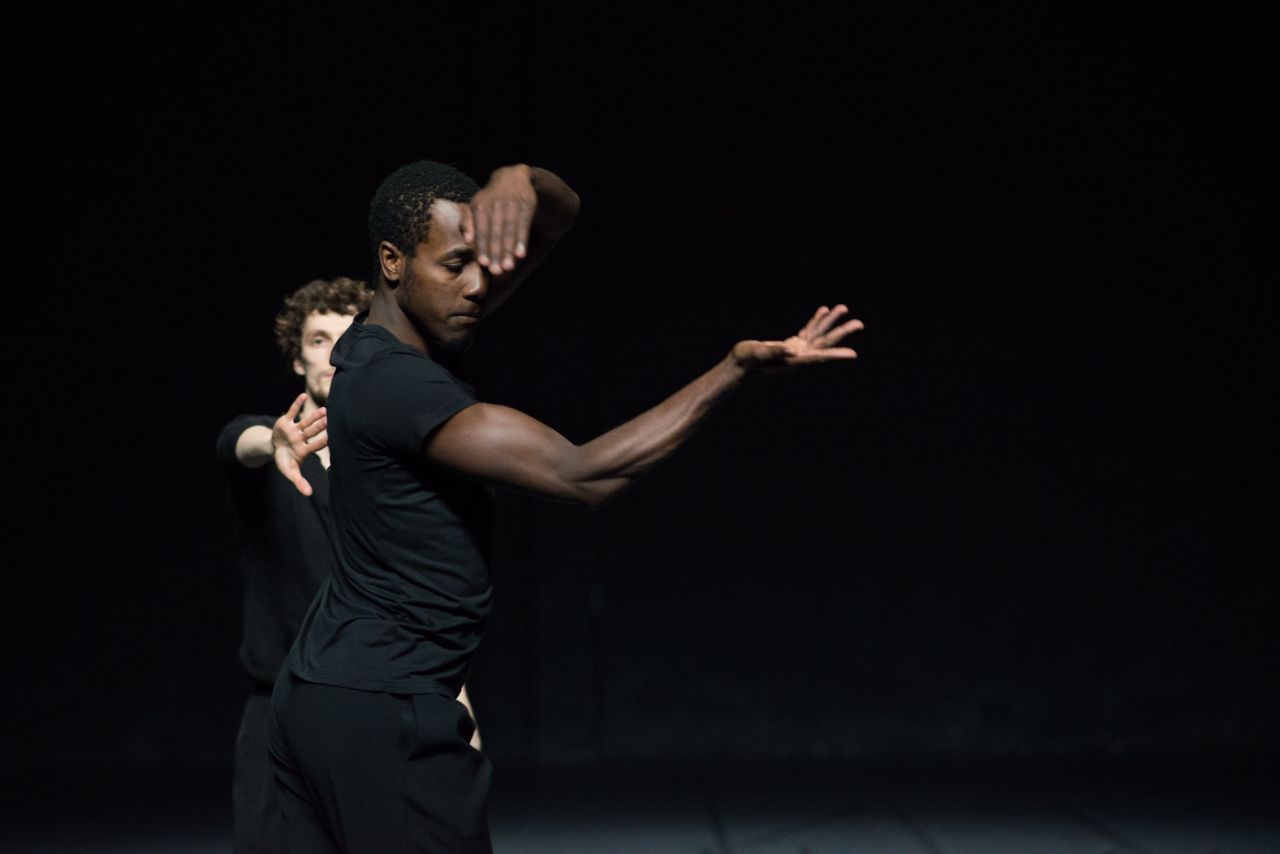
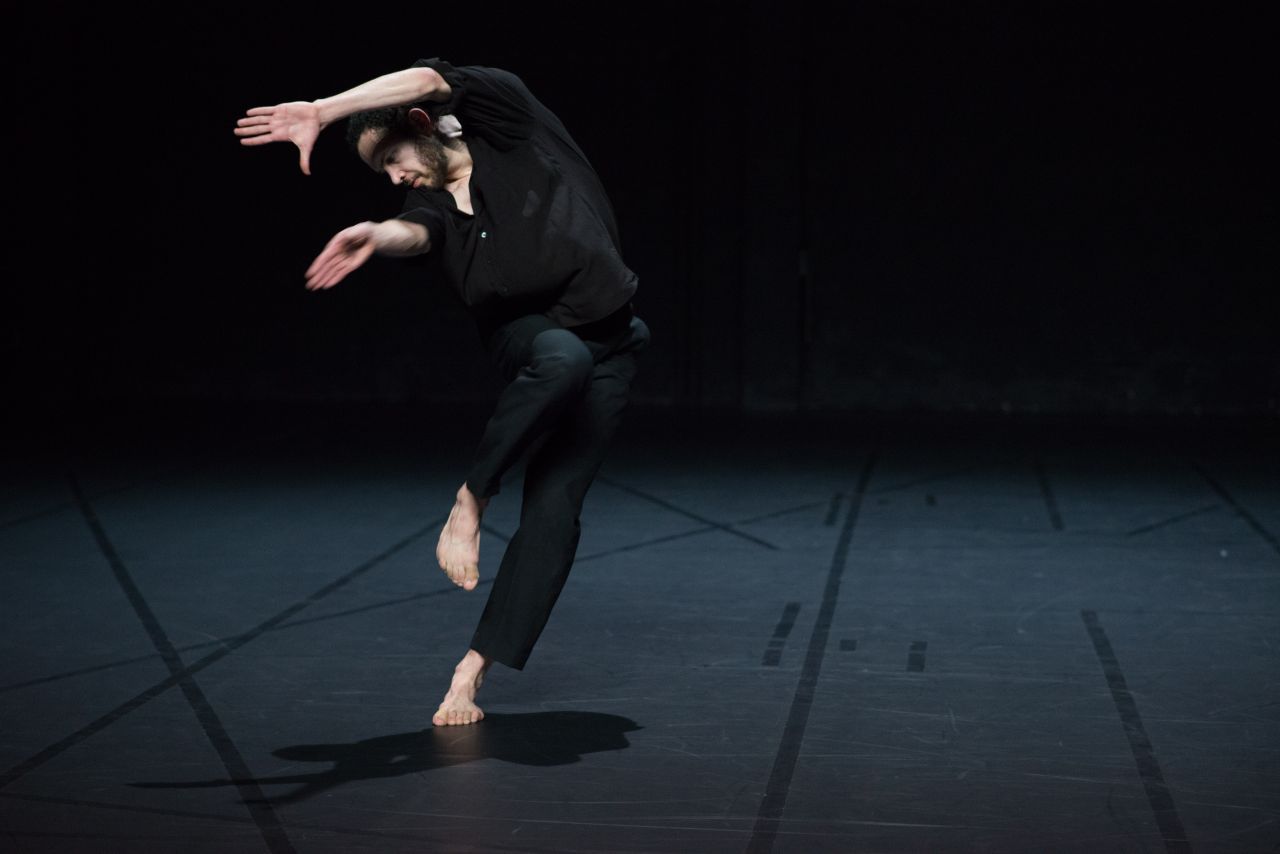
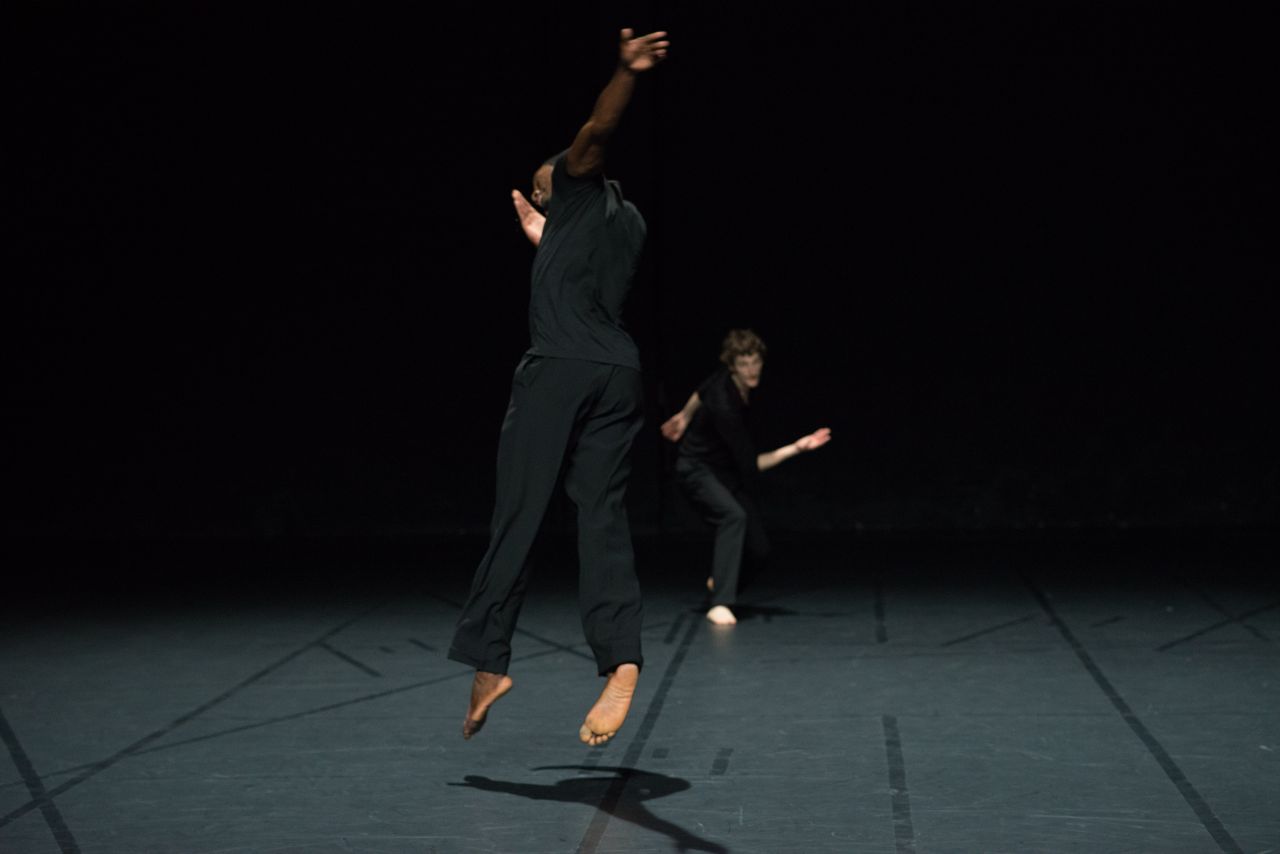
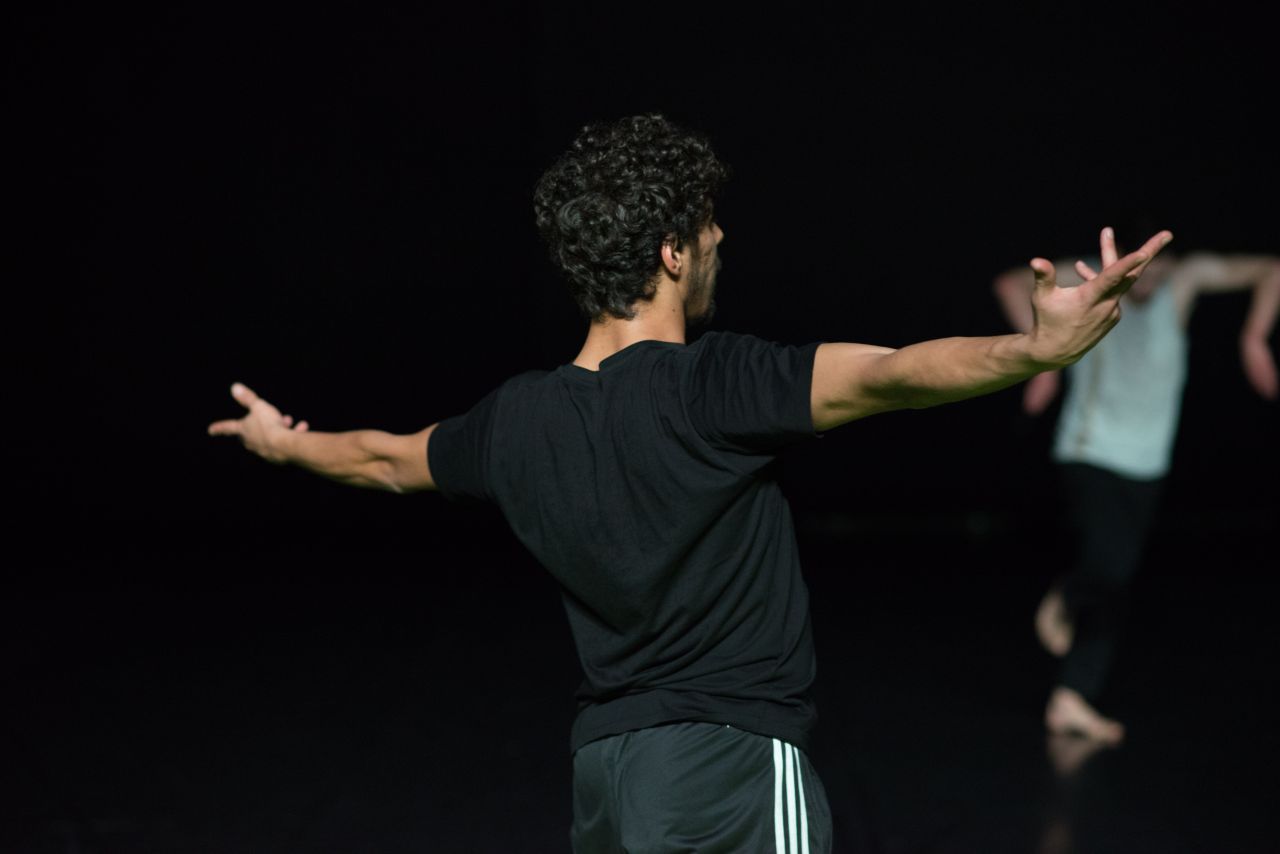
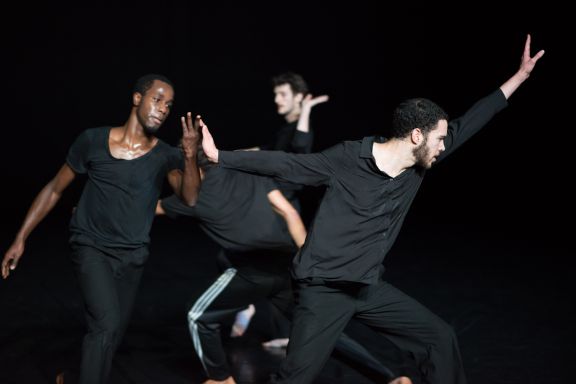
The current version reworks the original quartet for four young, male dancers — José Paulo dos Santos, Bilal El Had / Robin Haghi (alternating), Jason Respilieux and Thomas Vantuycom. Each of them is focused on the specific style of one of the musicians and his instrument, which creates a force field that reflects the energy and the dynamics of the original ensemble. The result is a strikingly vital performance in which the dancers surrender themselves to Coltrane's spiritual ode to divine love.
The performance takes place in the AB Flex format, a half-standing, half-seated configuration, and runs 50 minutes, starting at 8.00 pm.
Find interviews with the choreographers and the dancers below.
An Improvisation with Gravity
Interview with choreographers Anne Teresa De Keersmaeker and Salvia Sanchis by Wannes Gyselink, conducted in April 2017
With their new production, A Love Supreme, Salva Sanchis and Anne Teresa De Keersmaeker return to an old love. In 2005 they created—or, rather, wrote and improvised—a first version of their choreographic interpretation of John Coltrane’s masterpiece A Love Supreme (1964). The basic principles of the piece have remained the same: four dancers, each of whom dances a duet with each of the members of the Coltrane quartet. Still today, viewers have difficulty registering where the choreographies of these two extremely divergent yet like-minded artists blend together. Or, rather, where choreography stops and improvisation takes over.
It takes courage and humility to dance Coltrane’s legendary album. Indeed, A Love Supreme is as much a humble homage as it is a proud affirmation of Coltrane’s identity as an artist and believer—both a spiritual submission and an artistic assault on heaven. “One senses,” De Keersmaeker asserts, “that Coltrane’s record contains a unique accumulation of energy, a focal point for the creative powers of his quartet, his epoch, and his community.”
The final part of Coltrane’s suite (“Psalm”) is played without improvisation. Coltrane first wrote a prayer in words, then transposed it one syllable at a time to a melody played by himself. De Keersmaeker and Sanchis did the same in their piece, but the translational struggle they faced was of a physical rather than a musical kind: to transpose note after note of Coltrane’s music into movement. Sanchis—once a student at PARTS, now a teacher at the school in addition to being a choreographer himself—wrote out dance phrases for each of the core motifs in the first three parts of the suite. These constitute the raw material the dancers use to improvise. “The nicest compliment we received,” according to De Keersmaeker, “was from Fabrizio Cassol, the saxophonist of Aka Moon. After having seen the performance, he informed me that he thought it was simply impossible that the piece had been improvised, since it was far too precise. I think that’s exactly what we’re aiming for: the impossibility of ever truly distinguishing between the written base and the improvised material.”
How do you explain the audience’s inability to distinguish between what is written and what is improvised?
Sanchis: I understand your question, but I’m afraid it reveals some persistent misconceptions regarding the notion of improvisation. Improvisation is not a style; it’s not even an aesthetic choice. At most it is—like writing—a way to “get” oneself to dance. The whole idea of improvisation as “not knowing what is going to happen” is not helpful. In essence, I mean to do the opposite: if nothing is cast in stone beforehand, some additional guiding elements are required. This has less to do with curbing freedom and more to do with giving direction. That A Love Supreme seems improvised is not because the written base material appears so open and extemporaneous. Actually, it’s precisely the other way around: one renders the set material precisely, as precisely as possible, so as to force the improviser to be as precise as possible too. I want to improvise such that you believe everything I do is the only possible thing I could do. And that I did it exactly the way I wanted to. I don’t want you to see that I’m searching, that I’m still figuring out what to do at that very moment. I want to make my improvisation look as clear and as precise as possible, as determined as can be.
What, then, is the added value of having those moves improvised?
Sanchis: A sense of involvement, dedication. During improvisation dancers operate with a higher degree of intuition, with an “incorporated experience” in play, which results in a more authentic rendering of the piece. As an improviser, you hit certain combinations of movements, doing things so quickly and in such detail that it is impossible to write down. Maybe you could, but it would take an enormous amount of time. In that respect, improvisation is also simply more efficient.
De Keersmaeker: Another striking thing about improvisation is the balance one has to maintain between creativity and receptiveness, between speaking and listening. This also holds for the dancers of A Love Supreme. Some of their movements are chosen consciously, others simply “happen” to them. Sometimes they are dancing, sometimes they are “being danced.” These are decisions that the dancers themselves are in charge of, but there are also options that present themselves spontaneously, which may subsequently be integrated into their personal choreographies. Strangely enough, as a performer, I recognize that very experience of passivity, but in a converse situation: the sense of freedom when I’m dancing material written out in extreme detail, like the score for Piano Phase. The tighter the structure, the freer the experience. It’s as if one zooms in on a millimeter-long maneuvering space while dancing and, as a result, another immense space opens up within it—a space with innumerable possibilities and variations. That comes very close to Salva’s experience when he is improvising, the only difference being that we arrive at it from entirely opposite directions.
Sanchis: In the end it really makes no difference. Yet only in the end.
To Coltrane, A Love Supreme was an outspokenly spiritual statement. How, as a choreographer, do you approach the spiritual energy he meant to convey?
De Keersmaeker: To me A Love Supreme is essentially about defying gravity. It is about the relationship between humankind and the planet, between the vertical and the horizontal. That’s what having a spine allows us to do as humans, of course: to organize our center of gravity to render it perpendicular to the Earth’s surface. It allows us to move away from the gravitational energy exerted by the Earth with maximum efficiency. There is an ambiguity in that, which is also contained in Coltrane’s music. It reaches to the heavens in homage to the divine, but reaching to the heavens also implies an aspiration for boundlessness, for flying, for suspending gravity. It involves an element of hubris, which probably makes it all the more human.
Because, obviously, the task of suspending gravity is simply beyond us.
De Keersmaeker: Indeed, that is a given, much like the fact of mortality. One cannot dance beyond gravity. However, one can try to dance with it. One could compare it to the centrifugal movement that allows a runner to run at an angle, as long as one does it quickly enough. Or the game of loss and recovery of balance. That doesn’t even require a very spiritual perspective. The way somebody walks, somebody’s gait—in other words how somebody “deals” with gravity and the verticality it entails—automatically carries an emotional connotation. Somebody who lets everything hang, or somebody who walks with their head held high, take on two entirely different postures not only physically but also in relation to the world. Much like those postures, our relationship with gravity also concerns our relationship with the divine. The tension between the two, between us trying to reach out and us keeping to the ground, is what makes us human. It might pose a limit, but it also defines us as humans.
In the fourth and final part, the “Psalm,” whose musical score has the most explicitly religious feel, the visual language of the choreographer also seems to flirt with religious iconography.
De Keersmaeker: It is in any case the first time the dancers actually come to touch each other in the piece. It is only at this point that they remove themselves from their personal struggles, their own dance with gravity, and provide one another with mutual support—they now have to keep one another from falling. Beyond that, they take turns lifting one another into the air. Any notion of internal hierarchy now vanishes: it is about caring, about carrying one another. It’s an activity with a strong sense of physical empathy. In essence, the dance now becomes more pictorial or sculptural. As a spectator, you might feel like you’re facing forms of iconic imagery you recall from art history, without being able to quite put your finger on it. For that task the dance doesn’t reveal quite enough yet—it remains too abstract. Or maybe too concrete. Ultimately they are just dancers lifting each other. Above all you see a form of surrender, vulnerability, and therefore also trust. On the one hand, A Love Supreme suggests a love aimed at the divine, something that is “supreme,” but on the other it suggests that the ultimate form of love is really neighborly love, to literally carry each other. It could also be a form of playing together, like the quartet does—putting one’s own ego on hold, making oneself capable of collective communication.
Sanchis: The final scene could also express a simple idea: that you are not going to make it on your own. You notice that when people are confronted with something bigger, like the attacks in Brussels, the first thing they do is call somebody, talk about it, mourn together.
Spirituality doesn’t necessarily have to be transcendent.
Sanchis: While creating the piece, we talked a lot with the dancers about what we understood as transcendental in the first place. Take for instance the blues scale at the musical core of A Love Supreme’s theme. It is a scale with five notes, which is the same number as fingers on the hand. It is a scale that is equally present in every human culture, from Japan to Africa to Europe, as if there is something out there that people plug into everywhere, independently. Even our traditions and the experiences encapsulated in our genetic makeup express themselves in and through us. You could say that this transcends us, yet it is present in us, fixed inside us, like a kind of ancient sediment. It appeals to an experience of the world that predates language. That is precisely why I often find musicians enormously spiritual, because they communicate outside a regular linguistic register and can express experiences beyond the merely semiotic. Dance is also like that, but more grounded by its very nature, and thus more earthbound. Dancing is simply impossible when separated from the ground we stand on. This makes dance at once abstract and concrete: bodies moving in time and space, with gravity as support, as a counter-force, a liberating form of confinement.
SENSITIVITY AND SUSTAINABILITY: DANCING TO A LOVE SUPREME
Interview with dansers José Paulo dos Santos, Bilal El Had, Robin Haghi, Jason Respilieux and Thomas Vantuycom by Floor Keersmaeker, conducted in June 2019
In 2005, Anne Teresa De Keersmaeker and Salva Sanchis created A Love Supreme as part of a combined program with Raga for the Rainy Season. Twelve years later, in 2017, they challenged themselves to rework their choreography to the iconic album by the John Coltrane Quartet. This time they confronted the music with the performance of four young dancers: Thomas Vantuycom, Bilal El Had, Jason Respilieux, and José Paulo dos Santos. Robin Haghi joined the cast at a later stage. Two years and more than 120 performances later, I sat down with “the band,” as they somewhat facetiously call themselves, to hear their story of how to dance to A Love Supreme.
Was this production of A Love Supreme your first encounter with the music? What was your first impression?
José Paulo dos Santos (JPdS): I already knew the piece. I started out as a tap dancer, and we’d work with a lot of jazz music. I thought A Love Supreme was one of the best pieces to study. The first thing that came to my mind was the sense of a ritual, especially in the last part, “Psalm.” It felt like something that came out of the body.
The spiritual aspect struck you?
JPdS: Yes, exactly.
Jason Respilieux (JR): I hadn’t heard it before, and I remember not really liking it at first. I was almost annoyed with it, but somehow I kept listening. I couldn’t push the stop button—something was keeping me on track. And there were also beautiful moments. After the climax in “Psalm,” for instance, I was overwhelmed. Listening to this music was a real roller-coaster for me at first, and it still can be even now. There are moments that I love listening to it, and other moments that it doesn’t fit.
Robin Haghi (RH): My first encounter was when I watched the performance of A Love Supreme when Jason and Thomas were doing it in P.A.R.T.S. [Anne Teresa De Keersmaeker’s dance school]. So I first heard the music while also watching the choreography. It was only after I got involved in the project, having listened to it over and over again, that I found a way into the music apart from the dancing. But the first contact was from the outside, so to speak, watching and listening.
Thomas Vantuycom (TV): As with Jason, my first encounter was also through doing the piece, but this was the student version Robin refers to, in 2012. At the time I was getting interested in jazz, exploring it through the landmark albums. But I hadn’t yet arrived at A Love Supreme, and my first feelings were also a bit mixed. The jazz music I had encountered so far was relatively accessible. Like David Brubeck, very laid back. A Love Supreme comes from the opposite scale, and it poses a challenge to its listener.
Bilal El Had (BE): For me it went the other way. I wasn’t so into jazz before I started working on A Love Supreme. But this experience certainly opened the door for me. Since the piece is quite complicated, learning more about it and getting to know how it works helped me begin to understand other jazz music as well.
How about the physical response as a dancer? Do you feel that your body and your movements relate differently to this music than to classical music or pop music? Is there a different physical involvement?
BE: Both yes and no. Dancing to jazz music affects your body differently, of course, than with classical music, because the rhythm, the flow, and the harmony are so different. But in A Love Supreme a lot of the music is based on improvisation, so you use these tools or mechanisms of improvising, which are very linked to the tools the musicians use to improvise. And you could use these tools to work with many other kinds of music too.
TV: Not so much in actually dancing to the music, but in writing dance to a jazz piece, the difference is that within jazz, improvisation plays such a key role, much more than in classical music or pop. The general tools or rules of writing dance to music are also applicable here, but the way in which it happens is quite specific to the genre of jazz: the act of improvising while relating to a theme, and incorporating that theme into the choices you make. The exercise involves relating to one another while at the very same moment not necessarily knowing what is coming, because it is improvised.
Let’s look into that tool of improvisation that is so specific to both the music and the dance of A Love Supreme. As a concept, it is quite elusive. What does it actually mean, and where is the line between improvising and writing? And as a practice, was this kind of improvisation something that you had to grow into, get accustomed to? Did you find it difficult, and how did you make it your own?
JR: When I see Thomas, Robin, or Bilal improvising, I would say that in a way, it is so structured that it almost gets set. But at the same time, it is clearly not completely fixed. It is obvious that they are doing different things every evening. The conventional wisdom is that improvisation opens up a whole spectrum of absolute freedom, but actually, for them, it is sometimes even more restrictive than for me and José [dancing bass and drums, roles that do not, or include less improvisation] given that we’re dancing fixed, pre-written material. We know what we have to do, but for them it’s a constant negotiation between all the tools and their juxtaposition.
BE: Here’s something I learned from this experience: in order to improvise, you have to make rules. Otherwise, you just improvise for nothing. I have a background in hip-hop, where improvisation is also important, but the tools I used there were different. I worked with what I already knew, so the improvisation was more intentional. What I learned from dancing A Love Supreme is instant improvisation, based on a set of tools linked to the music.
How does that work exactly? How, when improvising, do the dance and the music relate to each other? Intervene or intertwine? Is it about using and exploring different combinations of variations on themes, spatial forms, phrases?
TV: John Coltrane was famous for playing very well-known melodies—My Favorite Things, for example—and improvising on them, sometimes going into solos for an hour at a time. But still, each time, you would recognize the original melody. So there is something in improvisation that creates a difference, while at the same time maintaining a core that directly links to the original, making it recognizable even if the shape is different. In dance, improvisation is the same thing. From performance to performance, there is indeed a lot that is exactly the same work, or at least very similar. There is a phrase running, a set phrase, and we relate to the shapes, the space, and the rhythm of that phrase, the timing. We relate to the music, obviously, to its intensity, rhythm, texture, and dynamics. There are spatial choices, and there is also the relationship you have with your own body on that specific day. And all of these things together make a pool of tools. There will be small variations, but it is true that over many, many performances, improvisation will start to look similar or recognizable in the same way that a melody is recognizable even in another form.
This brings me to a question about whether it gets harder or easier to keep improvising the longer you dance the piece. Over time, you also get to know the music by heart, to the extent that you could sing it note for note, even backward maybe! Is it challenging to maintain improvisation over 120 performances?
BE: Even when you know this music by heart, even after hearing it so many times, it is still so complex that it manages to put you in a place where you are not comfortable. So no, it doesn’t get easier.
JPdS: One crucial thing about improvisation is indeed how to keep it alive, how to refresh the form every time, especially in A Love Supreme. When jazz musicians improvise, they are always insisting on refreshing, bringing something new. I think in our case it is more or less the same: we insist. Every time we try to create something interesting for the audience to see. For me it’s all about insisting on getting better.
Is it something you can practice?
JPdS: Yes, improvisation actually grows through practicing.
RH: More specifically, I’d say there are elements of improvisation you can practice. But actually doing it cannot be rehearsed outside of the act itself. Practicing improvisation is also very different depending whether you are studying it in school or working with it on stage. In connection to what José said, the thing you can get better at, for me at least, is directing your energy toward the music, or finding ways to re-express that specific moment of the music, that specific situation, in the dance, the choreography, and the setup.
You are each connected to a musician, a particular instrument and personality. But arguably the magic of the music lies in the interplay of the musicians and the dynamics among them. How do you incorporate that aspect into dancing, an art that doesn’t make a sound of its own but mostly depends on the visual for creating, for example, harmony?
RH: As in every performance art, there are evenings when it works better and evenings when it’s less great. I remember our first performance in Japan, when we were acting too “separate” as individuals. The next night we decided that we would focus more toward one another, with direct intention and playfulness, and create a bit of risk. An important element is the direction of what you are doing both toward the audience and toward each other. If you can balance it, it often becomes quite tangible.
So there has to be intentionality?
TV: It has everything to do with sensitivity—sensitivity to what each one of us is doing. Once again there is the analogy with music: when everybody plays their notes correctly and beautifully, the music still might not sound nice. But if everyone is sensitive to playing together, to creating harmony and groove, that’s where the making of the music actually starts. The same goes for us dancers: reacting to each other, making decisions together even if you don’t know what the outcome is going to be. It’s all very subtle, but it’s what makes the performance unified, makes it work.
You all have your own parkour, your own trajectory as a dancer, in which A Love Supreme has a specific place. How has this experience contributed to the dancer you are now, and what parts of it will you take along with you into the future?
TV: My answer might be a bit cheesy! But doing the piece in school was an important, emancipatory experience for me, as it was the first time I felt I had a specific capacity I could identify with. I felt that performing improvisation was something I could do, that might be specific about me. When you’re in school, you start out as part of a kind of gray mass, and eventually everybody becomes a specific cell.
JR: I am struck by how different my experience is from yours, because our roles are so different. A Love Supreme contains very different work for all of us. José and I have a rather in-between position where we need to execute the material but we’re not up front like you, Bilal, or Robin, whose work is directed toward the audience. José and I are in a sense “polishing” around that. While this position might be a bit low key, it is equally important because it serves as a diving board to what the others are doing. It gives importance to it. It’s this relationship between the two that creates the tension that makes it all work. Someone improvising on that music alone, by him- or herself, would probably appear too open-ended. To make it interesting for the eye you need to build a texture around it. What I’ll take away from this experience is the aspect of sustainability, of positioning yourself so as to keep the group together. I learned here what this position means, and how you might not necessarily perceive it at first glance. It’s a subtlety that is present in the music and also, I think, in our dancing. It is present in some kind of hierarchy without being inherently hierarchical.
JPdS: This for me has been the only production where I felt like a human being. This is because the piece is actually about caring, about making connections with one another. “Psalm” literally involves carrying each other. We form a small constellation.
A Love Supreme has received very positive reviews, and audiences respond with a lot of enthusiasm. In all modesty, do you have an explanation for this success?
JR: I’d say we’ve witnessed a big conceptual wave in art and contemporary dance, but now there’s the demand for the body again. This piece is physically so engaging, it meets this demand.
JPdS: This also makes the piece quite accessible. The level of interaction is so direct. There is nothing to translate, to think about. It’s just there, through the dancing bodies. It’s concrete. It’s dance and music together.
RH: What also makes it special is the fact that compared to a lot of other jazz pieces, A Love Supreme covers the whole the spectrum of intensities and sentiments. You have moments that are very delicate and moments that are very lyrical; moments that are incredibly energetic and moments when it gets almost aggressive. And it goes up and down through the whole piece. Whenever we hit those moments in our performance, the result is always of a very high level. There is a lot of quality in the composition, the phrases, all of the different solos, from the drums to the bass to the improvisation. Even though the audience might not entirely know, from the outside, what they’re witnessing, they still get that sense of something well crafted, well performed. They can feel it. I suspect that the simplicity of the setup somehow helps convey that we are very confident about what we are doing. Not that we are always confident, but the confidence in the work is there.